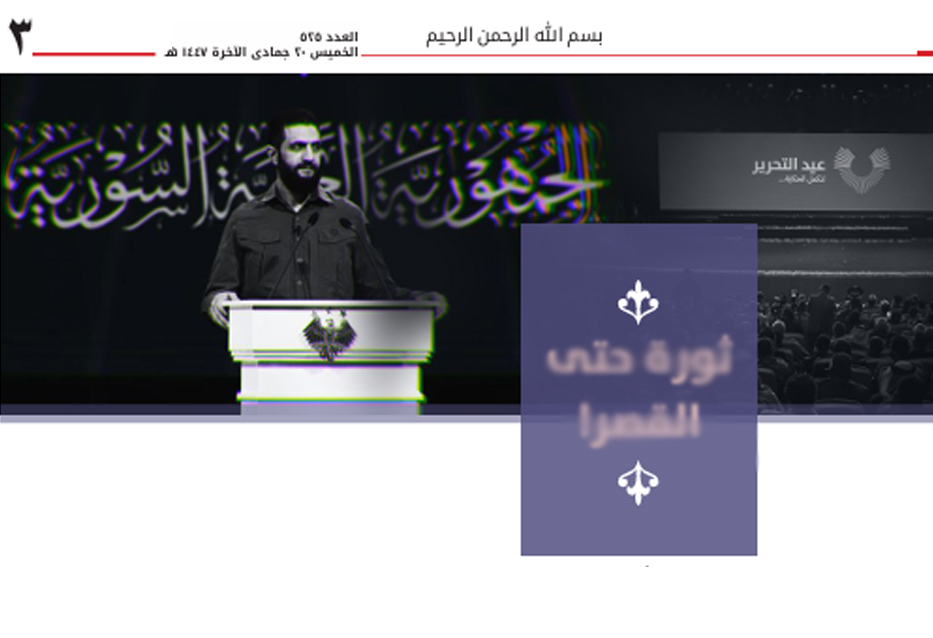
“The lion (in Arabic the word “beshar” means lion –which also the name of the former dictator Beshar Assad) is gone, the hyena has arrived, and the country remains as it is, governed by the law of the jungle (chaos).” (a
quote from al-Naba’s 525th issue)
Despite claims by U.S. officials that the Islamic State in Iraq and Sham (ISIS) was defeated in 2019, the organization continues to pose a significant threat to Syria, as well as to the wider Middle East. A recent attack on joint U.S.–Syrian forces near Palmyra underscored this reality. The assault, which resulted in the deaths of two American soldiers and one civilian, reportedly a translator, marked the first fatal attack of its kind against U.S. forces in Syria since ISIS’s territorial defeat in 2019.
In its initial statement, U.S. Central Command (CENTCOM) described the attacker as a lone ISIS operative, stating that “the attack occurred as the soldiers were conducting a key leader engagement. Their mission was in support of on-going counter-ISIS / counter-terrorism operations in the region”. Syrian authorities later revealed that the perpetrator was a member of the Syrian Internal Security Forces who reportedly held extremist or takfiri views. According to Syrian Interior Ministry spokesperson Nour Eddin al-Baba, officials had been aware since December 10 that the individual harbored extremist views and were planning to take disciplinary action on Sunday. The attack, however, occurred on Saturday—an official day off. This raised the possibility that the perpetrator was not a formal ISIS member but rather an individual influenced by ISIS ideology and propaganda. Local sources indicated that he was among approximately 5,000 newly recruited security personnel deployed across areas ranging from rural Aleppo to Palmyra.
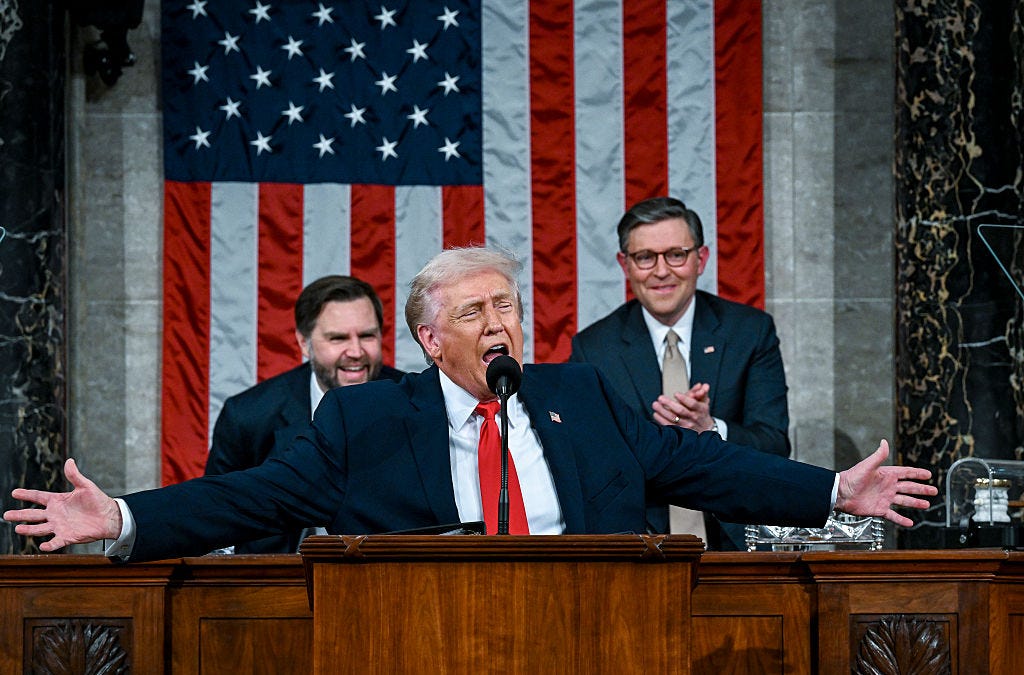
U.S. President Donald Trump characterized the incident as “an ISIS attack against the U.S. and Syria, in a very dangerous part of Syria that is not fully controlled by the Syrian government,” warning that “there will be very serious retaliation.” In the hours following the attack, the U.S.-led International Coalition—supported by Syrian security forces—arrested individuals in Palmyra. This operation was preceded by U.S. aircraft dropping flares over the city and the deployment of two F-16 fighter jets to conduct low-altitude flights as a show of force. Since last July CENTCOM, in cooperation with partner forces, conducted 80 military operations against ISIS.
Cooperation between the United States and the Syrian government against ISIS began as mutual intelligence sharing after rebel forces captured Damascus, ending Bashar Assad’s 24-year rule. Since then, the partnership has faced criticism not only from former opposition figures but also from extremist organizations, particularly ISIS and the newly formed Ansar al-Sunna. These groups have framed Syria’s cooperation with the United States as a betrayal, accusing the new Syrian leadership of working with America “to kill other Muslims” or not ruling the Sharia Law.
Following the Trump–Sharaa meeting on November 10, Syria officially became the 90th member of the Global Coalition against ISIS. This development intensified dissatisfaction among radical Salafist factions, many of which fear that Ahmed Sharaa’s rule will not result in the implementation of Sharia law in Syria and in fact not making them comfortable to do so.
Islamic State organization articulated this position most explicitly in the 525th issue of al-Naba, its weekly newsletter published on December 11. The publication devoted an entire page to condemning the new Syrian government and rejecting the characterization of recent events as a “revolution” or “liberation.” The article refers to Sharaa—using his nom de guerre, al-Julani—as “Trump’s protégé” and mockingly labels him “the target of his perfume,” an allusion to the White House meeting during which Trump reportedly sprayed cologne on him. IS described Sharaa’s policies as “betrayal,” accusing him of having “written the darkest and most shameful chapter of contemporary Islam.”
Although the article focuses on recent developments, this criticism is not new. Tensions between ISIS and Sharaa date back to the early years of the Syrian civil conflict. After Sharaa founded al-Qaeda’s Syrian branch, Jabhat al-Nusra, Abu Bakr al-Baghdadi proposed unifying their forces into what would become the ISIS. Sharaa rejected the proposal, viewing it as strategically impractical. After that, gap between Al-Qaeda’s leadership and ISIS widened which led to conflicts between two sides and JN’s obedience to Al-Qaeda against ISIS. Reflecting on this period, article claims that “al-Julani fought throughout the years of his revolution with all his might (…) until he deservedly earned the American rewards that Assad failed to obtain; for his infidelity, his criminality, and his unique success in protecting the Jewish borders.”
The fall of Damascus and Assad’s fled to Russia, thus rebel forces taking over the capital without harsh external intervention, further unsettled ISIS. The group expressed particular resentment over the absence of aerial intervention during the rebels’ advance. One passage reads:
“He was allowed to enter presidential palaces on live television screens, under clear skies—skies that, under the Islamic State, were crowded with hostile aircraft to the point that two traffic policemen would be needed to regulate them. Not a single plane was friendly. All were hostile. And all of them disappeared during the days of so-called liberation.”
From a broader perspective, the article extends its critique beyond Syria, arguing that Arab states repeatedly follow the same trajectory:
“A national, patriotic, revolutionary struggle, beginning spontaneously and enthusiastically, without a systematic direction, is quickly hijacked by global forces of disbelief and exploited for their agendas through containment, convergence, domestication, and recruitment.”
According to ISIS, such processes culminate in symbolic “independence and liberation,” celebrated as national achievements while, in reality, Sharia law is abandoned. The article concludes that “like other revolutions, the Syrian revolution has ended, with Syria liberated from Sharia.”
The Caesar Act, U.S.–Syrian Relations, and ISIS’s Perspective
The article also addresses the removal of Caesar Act sanctions under provisions included in the U.S. National Defense Authorization Act (NDAA), portraying the move as “a gift to al-Julani and his regime.” While the Caesar Act originally targeted the Assad government, its relevance diminished following the regime’s collapse. Nevertheless, the NDAA allows for the reimposition of sanctions should the new Syrian authorities fail to meet U.S. congressional conditions.
ISIS sharply criticizes these conditions, which include cooperation with the United States against ISIS, the removal of foreign fighters from senior positions, guarantees of freedom of worship and belief, restraint from military actions against neighboring states, and progress toward international security agreements. The final condition, according to al-Naba, is effectively framed as ensuring “Jewish security.”
In line with its ideological framework, ISIS presents the Syrian transition as an international-regional arrangement designed to protect American and Israeli interests. The article denounces those who describe the United States as a friend of Syria, portraying America as a “Crusader” power and accusing Syrian leaders of total subservience:
“They are pleased by what pleases it and saddened by what saddens it. They ally with its allies and oppose its enemies. They live at its beck and call, eagerly awaiting its decisions and the signatures of its tyrant.”
The article also argues that the true objective of Syria’s “liberation” was the dismantling of the Iranian axis rather than genuine independence. In this context, it compares Iran’s strategic losses to Türkiye’s perceived gains under President Erdoğan, invoking the proverb “one man’s misfortune is another man’s gain.”
Conclusion
ISIS sees new authorities in Syria no different than the old regime, as they say in al-Naba’s 524th issue: “The Mujahideen place the “old” and “new” Syrian regimes on the same target list, as they differ in nothing except the shape of the flag.” That means that threat continues regardless of any change in Damascus, which must lead not only new Syrian government but also International Community to fight against it.