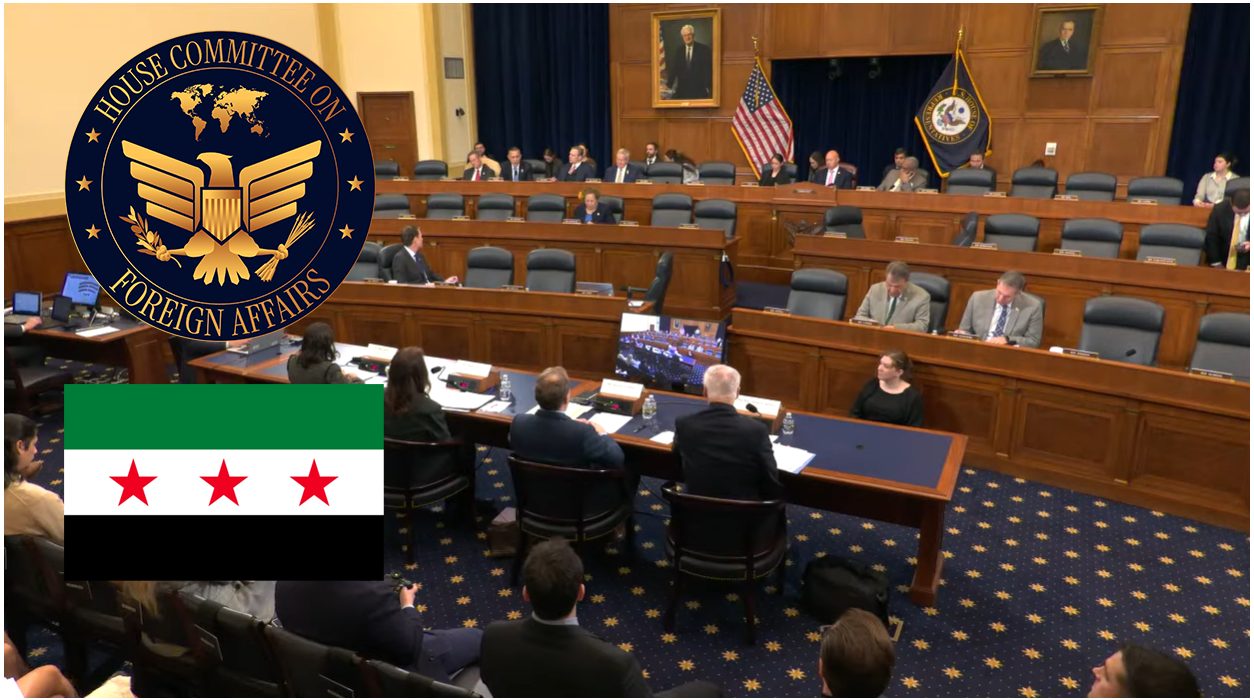
Titled “Syria at a Crossroads: U.S. Policy Challenges Post-Assad”, House Foreign Affairs Committee (HFAC) held a hearing on February 10th about the updates from Syria. Hearing hosted four experts;
- Former U.S. Türkiye Ambassador James Jeffrey,
- Washington Institute Martin J. Gross Senior Fellow Andrew Tabler,
- Former Chair U.S. Commission on International Religious Freedom Nadine Maenza and,
- Professor of Practice from Johns Hopkins University Mara Karlin.
Testifying before U.S. Representatives, experts answered questions about Syria’s domestic and foreign affairs regarding the country’s post-civil war transition era. Prior to his official visit to Washington to meet with President Donald Trump, Syrian President Ahmed al-Sharaa engaged with several members of Congress to discuss the lifting of the Caesar Sanctions which were originally implemented to penalize the Assad regime’s human rights abuses. During these high-level meetings, President Sharaa reassured lawmakers by acknowledging their specific concerns regarding minority rights, the resurgence of ISIS, and U.S. national security interests. To “give Syria a chance”, Congress approved the National Defense Authorization Act (NDAA), which includes a provision for lifting sanctions. The same legislation drew clear lines for the new Syrian authorities and request clarification “whether the Government of Syria committed itself to; fight alongside the U.S. against ISIS, provide security for minorities, is not taking military action against its neighbors and removed foreign fighters from senior roles.”
Latest HFAC Hearing discussed those conditions’ practical implementations on the ground and provided implications for U.S.-Syria bilateral relations and future of the country.
Key Takeaways and Main U.S. Concerns
Committee Chairman Brian Mast opened the Hearing with a pessimistic tone. Mast previously rejected the removal of sanctions until he met Syria’s Sharaa in Washington where they exchanged ideas. Reflecting a sharp reversal from his former stance, Mast noted that “ Syria is nowhere close to where they need to be today. The United States is not satisfied with the progress that he has made yet and views many of his actions as steps backward.”
From the very beginning of the hearing, it was evident that the White House and the House are not aligned and there is a policy gap regarding Syria’s future. Interestingly, despite the Republican majority in the House, Representatives appear to be distancing themselves from President Trump’s stance, at least in principle. Some of the indicator for this are the remarks of Trump, Secretary of State Marco Rubio and other White House officials as well as U.S. policy on the ground, which this article will examine later.
I – SDF’s Territorial Collapse and Minorities
Not only Chairman Mast but also other Representatives stated that while President Sharaa assured them regarding their specific concerns, those guarantees has yet to be met. On top of these topics was the minorities in Syria, particularly Kurds and Druze. Throughout the civil war, Congress’s steadfast support for Kurdish-led Syrian Democratic Forces (SDF) has had a significant impact on the ground. SDF, until recently, controlled 30% of the Syrian soil, a gain achieved through the fight against ISIS with sustained U.S. military and economic assistance. However, following recent clashes between the Syrian Government and the SDF, the organization lost almost all its territorial holdings within nearly 48 hours. This shocking development revealed that the U.S. military were no longer supporting a long-standing ally, especially against another partner. The possibility of renewed violations against minorities is one of the key concerns of the House, given the traumatic results of the Suweida clashes and coastal events which resulted in dramatic loss civilians including Bedouins, Alawites and Druze.
One example given by Representatives regarding the U.S. policy in Syria and towards SDF is the withdrawal of U.S. forces from Afghanistan in 2021 after nearly 20 years of mission in the country. Representative Bill Keating said the following words:
“It also reminds me that in terms of waning of US credibility of our proven allies, just the pulling back of SIV (Special Immigrant Visa) visas and everything from those people in Afghanistan who risked their lives to help support our troops in other actions in the world when the US are deployed or in actions in Syria. Are these the kind of signals that the US is no longer a trusted supporter of their allies?”
Andrew Tabler, in his opening statement, said that the U.S., regarding the minority and SDF files, playing “good cop, selectively bad cop” role, which is a strong statement that signals U.S. support for Syrian authorities.
While the House commended Presidential Decree No. 13, signed by President Sharaa during the height of the clashes to grant linguistic, educational, and citizenship rights to the Kurdish population—lawmakers remain cautious. Similarly, the U.S.-brokered January 29 agreement between Damascus and the SDF was recognized as a pivotal step toward the SDF’s integration into the national government. However, Congress emphasized that the credible implementation of this roadmap remains as the crucial test regarding Syria’s future.
II – Regional Stabilization and Syria’s Neighbors
Assad’s Syria functioned as an Iranian proxy and served as a primary battleground for regional and international proxy warfare. The United States has long been opposed to the Russian and Iranian influence over the country. Although the things have changed since December 8 and Iranian forces have withdrawn from Syria, U.S. Representatives remain deeply concerned about the possibility of either power regaining its influence.
Likewise, finalizing a defense or security agreement between Israel and Syria remains a top-tier priority within the House. While major issues between two countries involve border disputes and Israeli support for Druze autonomy, Representatives often reiterated Israeli concerns or interests regarding Israel’s northern border. Representative Josh Brecheen, for instance, criticized Syrian attempts to “have Russian bases in the south” and in his word “what we (the House) had all hoped would be a demilitarized zone”. James Jeffrey pointed out to important measures taken by Syrian authorities against the Captagon trade routes and significant gun smuggling attempts to Hezbollah or other parties. Noting the positive impact of these enforcement actions on the regional atmosphere, Jeffrey expressed optimism regarding the future of bilateral relations:
“The thing that is so important is that Sharaa has been fighting Assad and the Iranians for a decade and he is now doing his best with some success in blocking Iran to reestablish a foothold there and in particular as we heard earlier provide weapons flows to Hezbollah. So, it’s a very important Israeli security dimension to have somebody finally to their north that is not on the side of Tehran. For all of his problems that is for the moment Al-Sharaa.”
Türkiye’s role in the new Syria also discussed in the hearing. Representative Brad Sherman noted that “Turkey has historically been Sharaa’s number one source of aid” and asked Mara Karlin whether “Turkey pressed the government of Syria to be particularly hostile to its Kurds.” Representatives consecutively argued that foreign fighters in Syrian Arab Army ranks are “backed by Turkey”. Rep. Beechen said his belief is “(Türkiye’s President Erdogan)’s desire (is) to reestablish the Ottoman Empire, that means driving all the way to Jerusalem”. Türkiye regards the YPG, the main component of the SDF, as an affiliate of the PKK — which the United States designates as a terrorist organization — and as a direct threat to its national security. For years, Ankara’s Syria policy has largely centered on countering the YPG’s presence and preventing the consolidation of its territorial influence along Türkiye’s southern border.
Representative Joe Wilson, a proponent of the new Syrian administration, commended the Kurdistan Regional Government (KRG) for its support for stabilization in the region. Simultaneously, Wilson criticized the Kurdistan Workers’ Party (PKK), calling for an end to its destabilizing activities not only in Syria but also across Iraq, Türkiye, and Iran
III – Relocation and U.S. Boots on the Ground
In his beginning statement, Chairman Mast noted that: “There have been actions against the SDF that forced CENTCOM to relocate 7,000 ISIS fighters from detention facilities across Syria and move them into Iraq.” The detention facilities that held ISIS-affiliated individuals and their families have long been an issue of international community because of the humanitarian situation, the Islamic State radicalization inside the camps or the complex legal challenges regarding the repatriation of foreign fighters. SDF, with assistance from Global Coalition, had run the camps until recently. After offensive against SDF-held areas, U.S. sought to prevent any major crisis in the area, especially critical Al-Hol camp and Shaddadi prison, so relocate the prisoner to Iraq. And within a month, U.S. is expected to withdraw from Syria completely, which already withdrew from large bases including Al-Tanf, Qasrak and Shaddadi.
From a broader perspective, the future of U.S. troops in the region remains a contentious issue deeply tied to American public sentiment. Key questions persist: (I) What is the ongoing mission of U.S. forces in Syria, and (II) who are the new authorities Washington is choosing to back? The Palmyra incident, which claimed the lives of two U.S. service members and an interpreter, has intensified domestic skepticism regarding the mission’s viability. Furthermore, lawmakers echoed concerns over the controversial lineage of Ahmed al-Sharaa, with Representative Randy Fine bluntly asserting, “Once a terrorist, always a terrorist”.
Contrary to the Representatives, Trump is Satisfied with the Progress
Contrary to the prevailing skepticism in the House, President Donald Trump has consistently praised President Sharaa, expressing a high degree of satisfaction with Syria’s trajectory. On February 20, Trump remarked: “The president of Syria who I essentially put there is doing a phenomenal job. He’s a rough guy. He’s not a choir boy. A choir boy couldn’t do it, but Syria is coming together. Really coming together well. And thus far he’s been very good to the Kurds.”
This sentiment is echoed by Secretary of State Marco Rubio and the U.S. Ambassador to Türkiye and Special Envoy to Syria, Tom Barrack, both of whom view the new Syrian administration as a strategic ally and have signaled a strong willingness to cooperate.
In pursuit of this cooperation, the United States continues to advocate for the representation of the SDF within the new Syrian political fabric. The 2026 Munich Security Conference served as the most significant indicator of this policy. Washington invited Mazlum Abdi, Commander-in-Chief of the SDF, and İlham Ahmed, co-chair of the Foreign Affairs Department of the Autonomous Administration, to participate alongside Syrian Foreign Minister Assad al-Sheibani. In a landmark diplomatic moment, Abdi and Ahmed met with Marco Rubio and Sheibani under the Syrian national flag, signaling a push toward political integration and a unified Syrian front.
Conclusion
The U.S. Congress remains the primary arbiter of the future of U.S.-Syria relations. Because it holds the authority to re-impose sanctions, Congress effectively maintains ‘veto power’ over the country’s long-term stability. Although Chairman Mast clarified that the Caesar Sanctions were targeted specifically at the Assad regime and are not intended for reinstatement, the threat of new legislative measures remains a key policy leverage. Both the U.S. legislative and executive branches share a common goal: an inclusive Syria that respects all its ethnic and sectarian components. Achieving this transition is a formidable challenge given Syria’s history of internal violence, yet it is a mission that Washington’s new strategy views as difficult but no longer impossible.